June as a festival whirlwind

That started in Tennessee and ended in Vermont. Now, weeks later, everything rushes back to me as it simultaneously fades away.

Where did I go? What did I do? Who did I meet? What happened?

The basic answers flash in my mind, but the other ones take more digging. Looking back on traveling is like that. Certain moments shine so vividly, when you think about them, it’s like you’re reliving them all around you. But others inevitably dissolve. At the end, it feels like everything happened so fast; it’s like it never happened at all. At the same time everything was so incredibly real, raw, present. I guess it’s a mixture of both. When I look back, I just can’t believe that it’s already over (over in one sense of the word, anyway).

Isn’t life like that most of the time? Sometimes you have these in-your-face real moments where you’ve never felt more alive, where you’re just yourself. You’re reaching out for all those colors around you, and you’re actually catching them. And you go with it. Other days I just seem to fall into the spaces between the second hand tick. The in-your-face alive moments are the ones I remember. The ones I strive for.

We left for Tennessee the first weekend of June. Four of us stuffed into an old Subaru. We drove roads that paralleled the highways. We made frequent stops to let the car cool. We spent hours in Virginia lounging roadside and riverside.
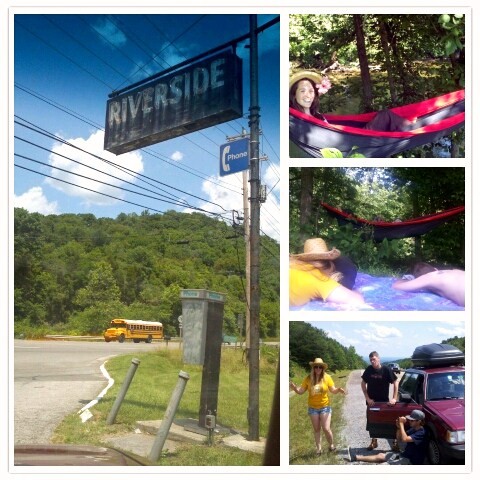
When we arrived at Clean Vibes’ headquarters to work the Bonnaroo Music and Arts Festival, emotions of all types flooded me. I was so grateful to be out of the car; I was overjoyed to be reunited with friends. Mainly, it was happiness. Clean Vibes employees live all over the country. The only time we’re all in the same place is Bonnaroo. I hadn’t seen many Clean Vibers since last summer. Tears broke in my eyes as I hugged old friends.

Clean Vibers are a special breed of people. How many people you know would pickup trash as a job? Would pickup schwilly, nasty bags of poop, god only knows whats and thousands of cigarette butts? No matter the weather conditions: streaming sunshine, pouring rain.

When I explain my job to other people they give me a strange look at first. “I’m pretty much a garbage lady at music festivals,” isn’t something you hear everyday. Clean Vibers are some of the most open-minded people I’ve ever met. Adventurers. Risk takers. Road Less Traveleders. Beautiful in every sense of the word. People with different backgrounds and hometowns coming together to make the world a better place, one cigarette butt off the ground at a time. Part of the reason I pickup trash is because of the amazing people I work with.

Where we camp

The Main Stage

Radiate Positivity: one of Bonnaroo’s themes
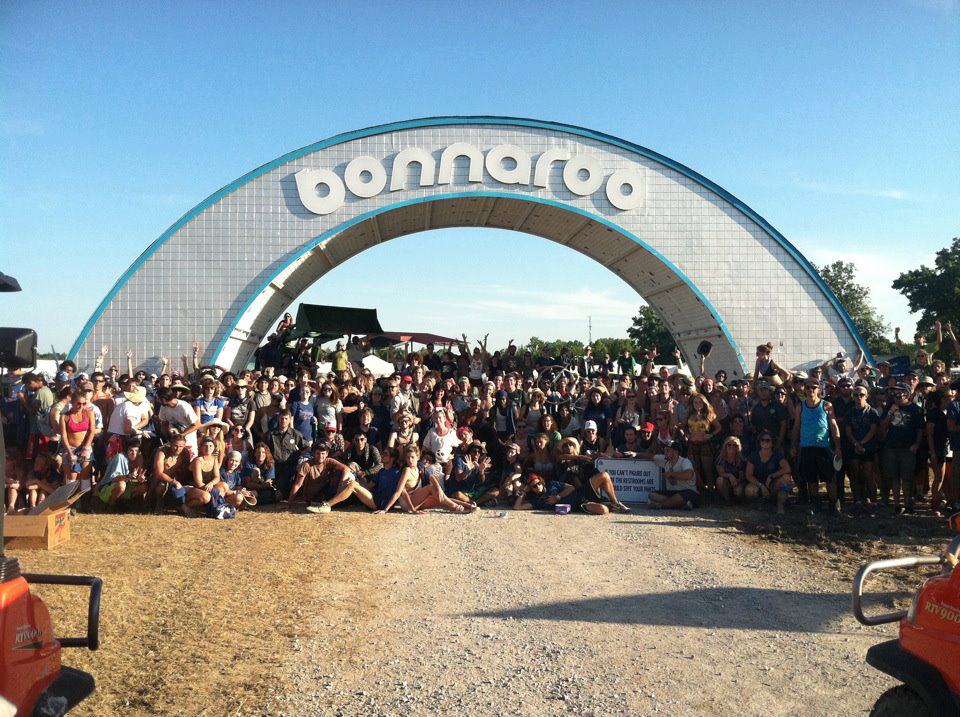
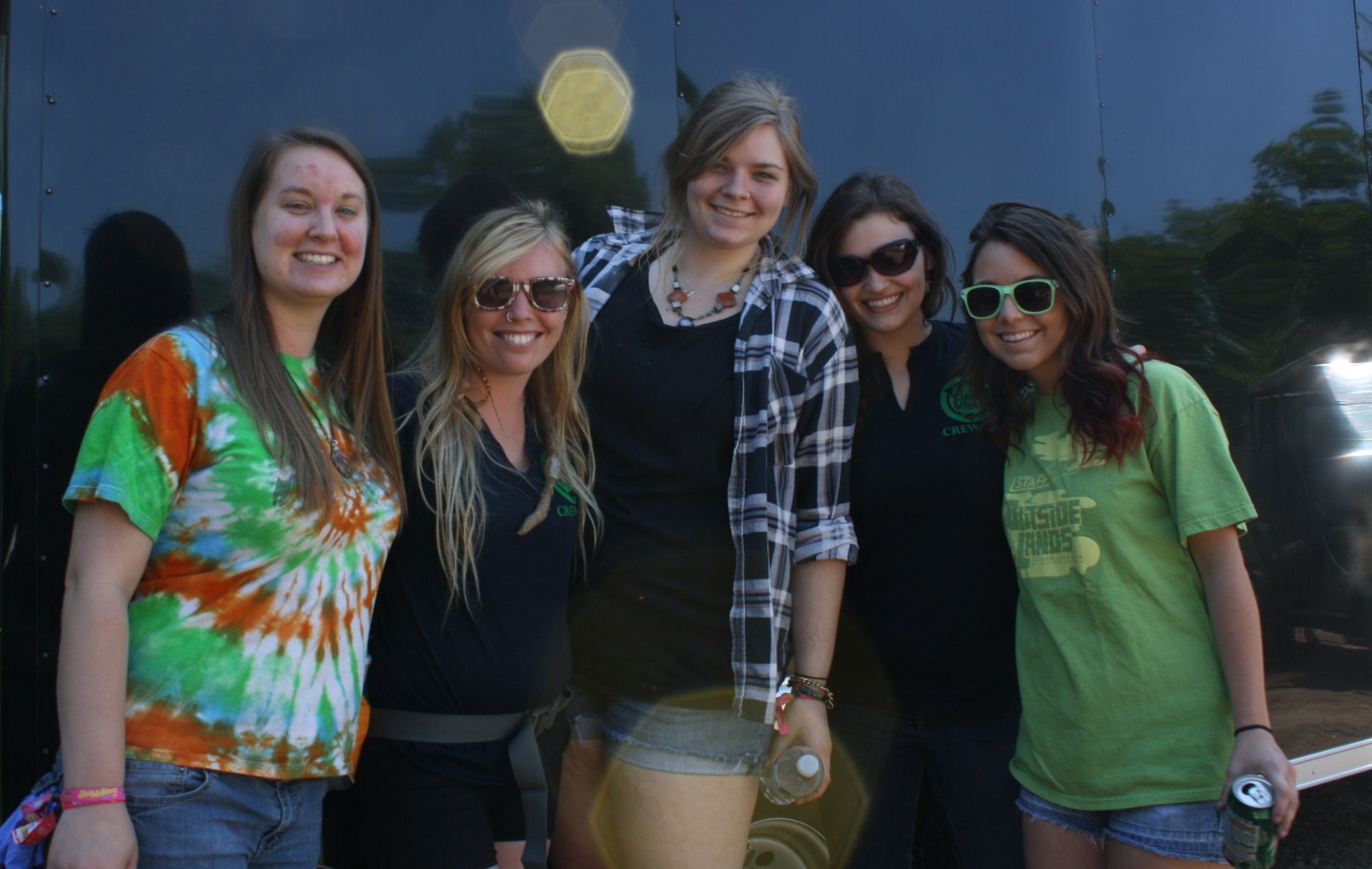
The whole gang-she-bang

We camp at Bonnaroo until all of the garbage is picked up and the 700-acre farm is more spotless than it was before the festival started. The cleanup can take a couple weeks. We live together, work together, eat in catering together, shower in stalls beside each other, party together, play together. Forget alone time and personal space. Needless to say you become a family fairly quickly.

This year at Bonnaroo I worked at the Clean Vibes Trading Post.
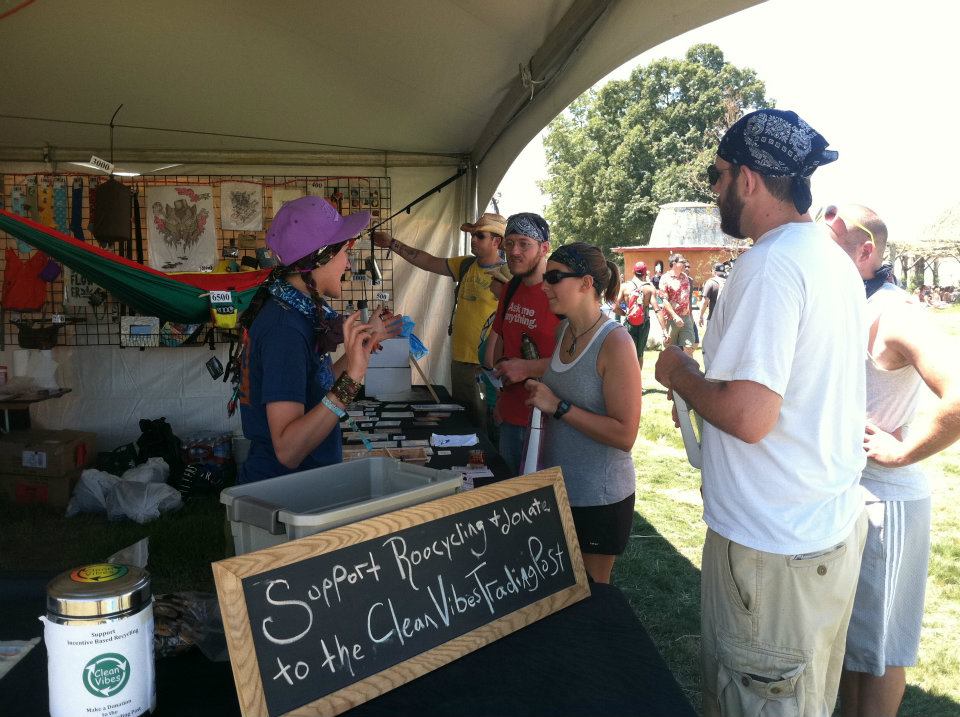
Here I am working the Trading Post for Clean Vibes

The Trading Post is a recycling based initiative program that promotes sustainability by encouraging festival-goers to recycle. We set-up a booth in Planetroo that’s pretty much a recycling arcade. Festival-goers bring us their recycling and in return they win prizes such as synergy clothing, platypus water bottles, concert tickets and many more. I loved spreading the word about Clean Vibes and encouraging people to help keep the scene clean. For more information about the Trading Post check out their website here.

Because I was tired most days after work, I didn’t see that much music at Bonnaroo. I saw bits and pieces of Soja, Rubblebucket, Feist, Ludacris, Dawes, Rodrigo y Gabriela, Radiohead, Red Hot Chili Peppers, and Phish. I loved walking around by myself, but I also loved being with a crew of Clean Vibers and dancing our butts off. My favorite part of Bonnaroo was the day after Bonnaroo at the staff party. There’s a DJ, karaoke, free booze, free food, the most crawfish you’ve ever seen and lots and lots of dancing.

Crawfish forever

After working three days of post-show cleanup we said goodbye to Tennesee and drove 13 straight hours overnight to Atlantic City, NJ, to work the next show, Phish. Phish played a three night run at Bader Field. Most of our crew worked the 4 p.m. to 4 a.m. shift.

Phish fans are some of the most respectful fans I’ve ever encountered. So many people came up to us to ask what we were doing, to thank us, and to throw away their garbage. So many fans were extremely grateful and appreciative of our efforts. Who doesn’t like feeling appreciated? Thank you Phish fans. I appreciate you and your appreciation.

Last summer when I worked my first Phish festival, Superbowl, I learned that Phish is much more than a band. I started to understand what they were all about and why thousands of people devote their lives to following Phish around. Phish is the community of people it brings together. Phish is the feeling and energy the fans create. Phish is being kind to strangers and accepting everyone. Phish is unifying. Phish is letting your freak flag fly.

Saturday morning after finishing work at 5 a.m. a bunch of us, the now dubbed ‘Breakfast Club,’ decided to explore AC. We visited one of our friends at a penthouse suite at the Chelsea Hotel; we frolicked on the roof of the Chelsea Hotel; we may or may not have gotten kicked out of some casinos and a bar, but we had an absolute blast.
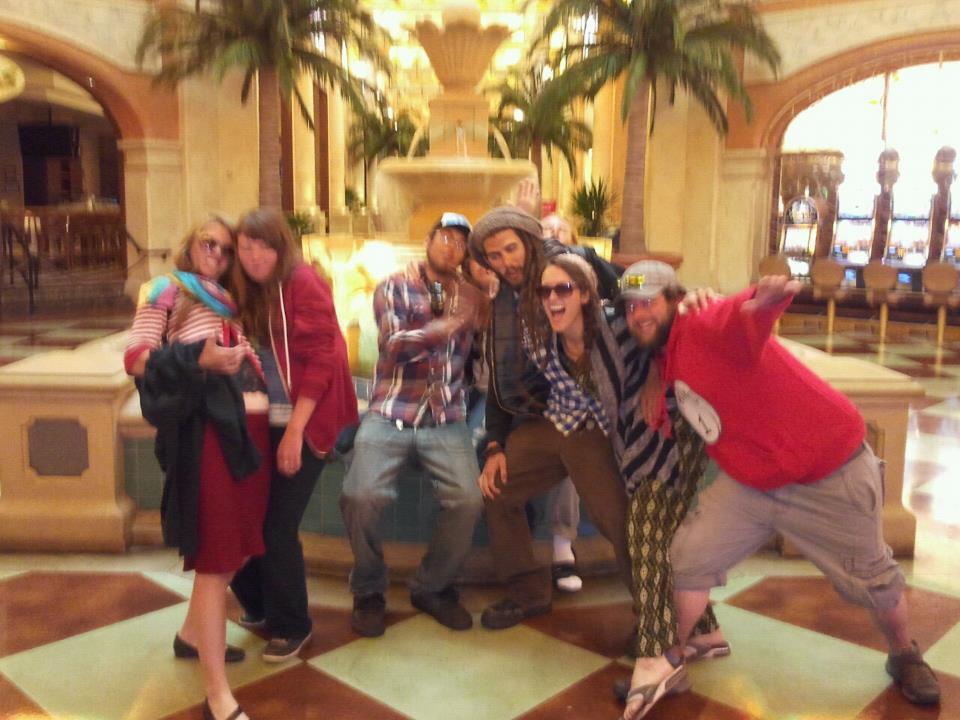
Things can get a little blurry around 7 a.m.

The Breakfast Club

A few hours later we woke up, started work at 4 p.m. and worked until there was no more trash on the ground. Going into the shift we were presented with the ambiguous time of ‘no more trash on the ground.’ Well, that ended up being until noon on Monday. We worked a 2o hour shift from 4 p.m. on Sunday until noon on Monday. By the time the sun comes up, you don’t know what’s real and what’s not. By that point I was delusional off of lack of sleep and all night work. But we all stuck it out and made it through together. Luckily we had each other for encouragement, silliness and love.

One morning before work my lovely lady friend and fellow Clean Viber, Angel happened to be outside talking on the phone at the same time I was. When she hung up she ran over to me and exclaimed, “I have a dream come true offer for you.” She offered me her Artist Hospitality position at the yoga and music festival Wanderlust in Vermont the following weekend. How could I refuse? Seize opportunities. After Phish I went home for a few days and then ventured to Vermont to be swept away in a land of yogis and more good vibes.

Part of the program

At Wanderlust I worked as an assistant to the head of artist hospitality. Our job was to cater to all of the artists’ needs. We food shopped for them, set up the green room, shuttled them to and from stages, filled coolers and did pretty much whatever they needed. By artists I mean Ziggy Marley, Ani DiFranco and Beats Antique. They were the headliners of the festival.

I was so grateful to be a part of such a wonderful festival in such a beautiful part of the world. The festival took place in the Green Mountains at Stratton Mountain Resort.

My ‘office’

I love everything about Vermont and I loved everything about Wanderlust.

A whole program filled with active activities!

Everyday (from Thursday to Sunday) there were guided hikes, multiple yoga classes, live music, lectures and more.

A description of the fest from their website, “Wanderlust is a one-of-a-kind festival bringing together the world’s leading yoga teachers, top musical acts and DJs, renowned speakers, top chefs and winemakers, and much, much more — all in a setting of breathtaking natural beauty. We’re talking about fun in the sun and dancing under the stars. Hiking on peaceful trails and gettin’ your down dog on at the top of the mountain. Sipping poolside cocktails with your friends, and then enjoying a tasty farm-to-table dinner with views of the surrounding mountain peaks. Early morning meditations and all-night chakra spinning musical performances – it’s an all-out ecstatic celebration in the most awe-inspiring locations in the world.”

I was pretty much in Heaven. It’s not too late to experience Wanderlust either! The fest is traveling to different parts of America and Canada. Wander to their website for more information.

I took a class called, “Unleash Your Inner Goddess” with Jennilee Toner. It was the best class I ever took out of any type of anything I’ve ever taken. After the class I felt invigorated, spiritually charged, empowered, connected, strong, loved, happy, refreshed, closer to the Universe, and ecstatic about life, love and the endless possibilities of this beautiful world we live in. It was just what I needed. I highly recommend this class to each and every person. Definitely check out Jennilee’s website and biography. She is such an inspiring person. If you’re ever in the Ballston Spa area in NY check out her studio.

As I finish typing this blog, I’m sitting on the floor of my childhood room gazing out the window at the tops of trees and bottoms of clouds. I’m thinking about those four questions I started the blog off with:

Where did I go? What did I do? Who did I meet? What happened?

Music festivals open up my eyes. After them I realize that I didn’t just go to festivals, but I escaped to a glimpse of what life can be when people strip away their insecurities, fears and doubts. When people join together in dancing, in stretching, in love. When people spend time outside, when people embrace their surroundings. I danced. I played. I loved. I woke up from the doldrums of everyday life. Life happened and it’s just going to keep happening. I’m going to strive to bring pieces of festival happiness into my everyday life and strive to constantly be alert and aware.

Namaste with love and light,
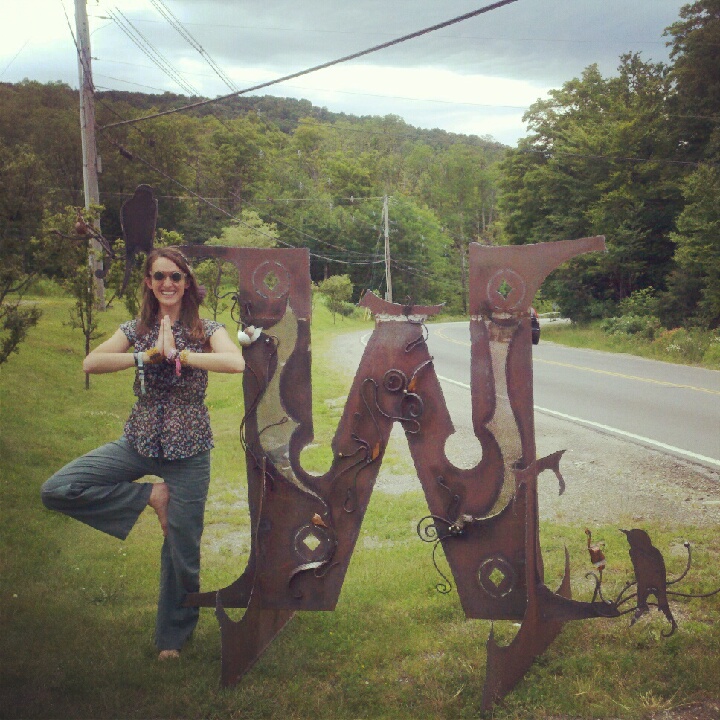
Clean Vibes at The Great Googa Mooga

For me the beginning of festival season is usually served with a nice, long road trip. This start of the season was slightly different. As half of our Clean Vibes crew headed south for The Hangout Music Festival, another handful of us headed north for The Great Googa Mooga. Since the Googa Mooga was in Brooklyn, from New Jersey I didn’t have far to journey at all.

This year was the very first Googa Mooga, a two day food and music festival set in Brooklyn’s Prospect Park on May 19th and 20th. Even though the weather was absolutely gorgeous and the best NYC restaurants were serving food and alcohol, for many festival-goers, the Googa Mooga was somewhat of a disaster. People waited in line after line after line to get everything from wristbands to money to water. Luckily for me, I worked on the clean-up crew and didn’t have to worry about all of those long lines.

Superfly Productions, the company that hosted the event, is giving a 100% refund to the Extra Mooga customers, those who paid $250 plus handling fees (the other tickets were free).

“We promised you a terrific Extra Mooga experience this past weekend and we didn’t deliver,” the organizers wrote on their website. “We’re very sorry if we disappointed you.”  Refund requests can be directed to refunds@googamooga.com and must be made within 30 days.

Clean Vibes

For my second summer in a row I’m working for the waste management company, Clean Vibes. Based out of Asheville, NC, but traveling nation-wide, Clean Vibes takes care of all things trash. For us Clean Vibers this means working pre-festival (mapping out and setting up stations for trash, recycling and compost), during the festival (cleaning up trash on the ground and servicing all the trash stations) and post-show (line sweeping the festival grounds and taking down trash stations).

Clean Vibes’ mission is to actively encourage and promote recycling, composting and proper waste disposal. Our goal is to divert waste from landfills by increasing the amount of material that is recycled and composted, thereby greatly reducing the ecological footprint of outdoor festivals and events.

Working for Clean Vibes last summer was one of the best decisions I’ve ever made. I met some of the most incredible people from all over the country, spent weeks outside without going inside at all, was constantly surrounded by live music and helped keep the Earth clean. I’m so grateful for the opportunity to work for Clean Vibes again this summer and spread the clean vibe to festival-goers.

Some of the lovely ladies I work with

Kate teaching us about a clearstream trash station.

Preparing clearstreams to set up throughout the festival

To learn more about Clean Vibes check out their website. Even though the deadline’s passed for a summer job, you can always volunteer.

Clean Vibes and the whole city shining behind us

Music Festival Season is Here!

Music Festival Season= Happy Season.

Dancing days are here again.

To me, there’s nothing in the world like those magical moments at music festivals when the band’s playing that song everyone’s singing along to as you lose yourself in the dance and become a part of it all. When people become stripped of material realities, possessions, and become united by the feeling in the air. When strangers come together as friends, as families, as one.

My festival forecast isn’t as filled as I’d like it to be this year, but I’m very excited for the ones I’m heading to.

I kicked off the season working for Clean Vibes at The Great Googa Mooga in Brooklyn.

Next week I’m headed to Tennessee to work for Clean Vibes at Bonnaroo. Happiness runs through my bones as I think about the weeks ahead.

Stay tuned for a post about working Clean Vibes at The Great Googa Mooga.

Keep on dancing and grooving as the summer air pulls us in,

Stay hydrated and happy!


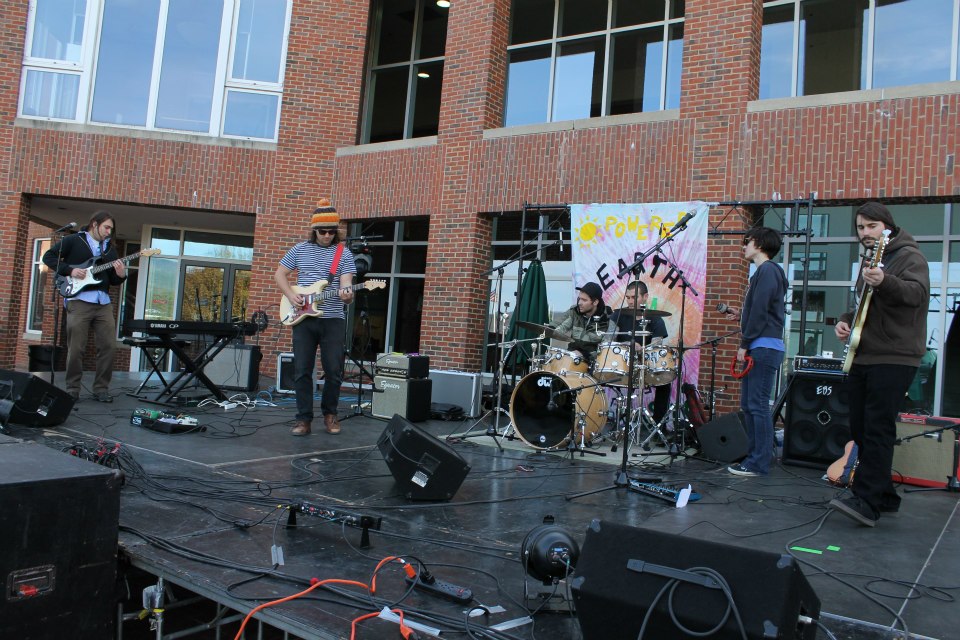
Earth Jam Festival at Plymouth State University

Over the weekend my friends and I roadtripped to central New Hampshire for Plymouth State University’s Earth Jam Festival.

We lucked out with a sunny Saturday with temperatures in the 50s-60s. (It was snowing when we drove up.)

PSU is wedged between one of the most beautiful parts of the East Coast: the White Mountains and NH’s lake region.

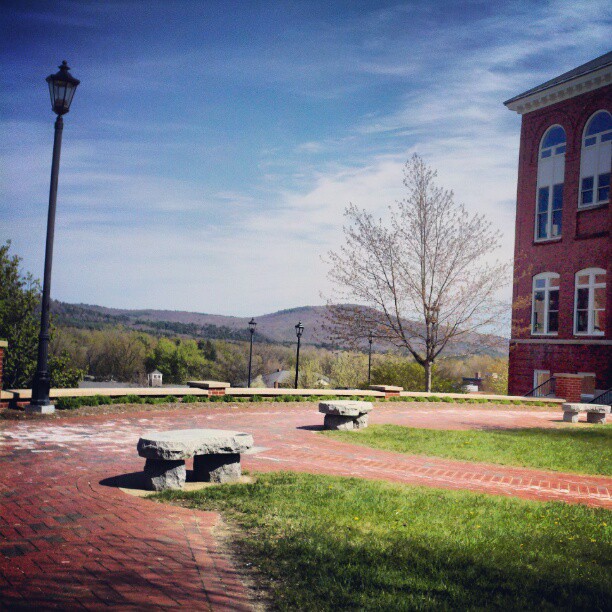
From campus you can see the White Mountains.

Plymouth is a quaint college town with a down home New England feel. Boutiques, a bookstore, an artisans’ co-op, a few pizzerias and bakeries dotted Main Street, which stretched for maybe a mile or two.

One of my favorite paintings at Artistic Roots. Artist: Fred Nold

The artisans’ co-op, Artistic Roots, was my favorite shop. Local artists display and sell their work there and split working time.

I love the feeling of exploring a town for the first time, of aimlessly wandering into shops and learning the character of a place and its people. I love talking to locals about the city they live in and what the place means to them.

After exploring town we went to campus for the festival. With an undergrad population of 4,3000, PSU has a comfortable small town feel. Aesthetically, it’s the kind of place with that distinctive classic New England look. But what made PSU special was the lack of pristineness. It was aged and beautiful but not so kept up that it appeared stiff. The grass was played on and lived in; some buildings were washed out and faded; vines clung to some walls.

Earth Jam is an annual free event hosted by Common Ground, a student environmental and social justice organization.

Hula hooping, slack lining, face painting, tie-dying, live music playing– that’s what sunny days are made of. Earth Jam consisted of those activities and more from noon till 11 p.m.

It felt so good to be a part of a festival again even if it was a small one day event. As I hula hooped barefoot, I grinned, knowing that festival season and happy days are just around the corner.

The stage ran on solar energy.

NJ band Indian Princess

While I was at the artisans’ co-op, I had a conversation with one of the artists about appreciation and priorities. We talked about her proximity to the White Mountains and how often she actually hikes. We agreed that nature nourishes us and spending time outside feeds our souls, yet we often get so caught up in other things that we forget what’s most important. We forget to take the time to really look around us and realize our surroundings. Why do we do this? Do we get so used to our realities that we forget to take a breath and look around?

Our conversation sparked some questions that I wanted to share with you all and think about myself:

What are your priorities? Where does nature and appreciating the Earth stand on this list?

What natural surroundings (forests, mountains, lakes, etc.) are around your home? How often do you take time to explore these places and appreciate them?

What makes you feel the most nourished, happy, whole?

How can you incorporate these activities (the nourishing, happy ones) more into your everyday life? Is there anything you can cut out of your world/spend less time on so you can spend more time doing what you love?

Feel free to share your responses in the comments section. I’ll be thinking about the questions as well and possibly posting another post with my answers.

Cheers to a continuous blooming and awakening into a nourished, happy, and whole life…for all of us.

Patagonia: Hiking to Heaven in El Chaltén

Getting outside brings out the best of what’s inside you. When I’m surrounded by nothing but mountains, trees, and sky, I can’t help but feel like I’m more a part of the Earth. When I hike, I hike to be outside, to be captivated by nature, to experience the natural rhythm of life, to learn how to be more in rhythm with this rhythm, and to learn how to listen to the silence and sounds that are already there without me.

This wonderful mass of the universe that we live on is already moving, breathing, living, and functioning on its own, without us. To be able to experience that buzz of life without interruption and to really feel like a part of it all. That is why I go hiking. I experienced that and more the day we hiked the Laguna de los Tres route in Chaltén.

Our first viewpoint: Laguna Piedras Blancas

With our Backroads group we started the hike around 9 a.m. Four of us finished the hike around 9 p.m., completing a 12-hour hiking day, encompassing 13.4 miles while summiting a 4,000 foot peak. The day, exhilarating, overwhelming, and exhausting, was one of the best hiking days I’ve ever had.

Like almost all of the days on our trip, every element of the weather came together to be the perfect formula for a hike. The sky was clear; there was no wind; and the air wasn’t too warm or too cold (temperature in mid-50s to mid-60s). But don’t be fooled by this too-good-to-be-true weather report.

Travel Tip: With Patagonia weather, you never know what you’re going to get. Be prepared (both mentally and gear-wise) for high winds, frequent and unpredictable showers (rain or snow), and intense sunshine at any time of the year.

We hiked through forests, fields, mountains, and stopped along rivers and lakes. One minute we were enclosed by tree branches with only glimpses of sky and peaks. The next we were walking into a wide open field, sky stretching all around us, with low, scrubby bushes at our feet. The next we stood on top of a mountain with snow-capped peaks staring back at us. With each step, we experienced such vivid contrasts.

Laguna de los Tres, the lagoon of the three, is known as the best viewing spot for the Fitz Roy mountain range. De Los Tres refers to the three highest peaks you can see from the lake’s shore: Fitz Roy (11,073 ft), Poincenot (9,849 ft), and Saint-Exupéry (8,392 ft).

                  The peak above the man in the gray is Saint-Exupéry and then to the right there’s Rafael, Poincenot and Fitz Roy.

Fitz Roy is the highest spire in Argentine Patagonia. Even though it’s less than half the size of the world’s greatest peaks, it’s one of the hardest peaks to climb. The difficulty is part challenge and part unpredictable weather conditions. The area has also been pretty inaccesible until the more recent developments of Chaltén. Hundreds of people may reach the summit of Mount Everest in a day, but Monte Fitz Roy may only be successfully ascended once a year.

Saint-Exupéry is named in memory of Antoine de Saint Exupéry, a French aviator who delivered mail to Patagonia by plane in the early 1930s. He’s also the writer of the best-seller, “Le Petit Prince” (The Little Prince). He disappeared while flying over the northern part of Corsica. His death remains a mystery.

Poincenot is named after Jacques Poincenot, a member of the French expedition set to conquer Fitz Roy in 1952. While attempting to cross the Fitz Roy river, Jacques fell in and died. His team carried on and named the peak in his memory.

After about 5 miles of hiking through the forest and fields, we decided to power on for the climb to Laugna de los Tres. Up until this point the views had already been incredible. But it was about to get even better.

While mapping out the trail in the dirt with his hiking pole before our final steep climb, David, our local guide, said, “You’re going to arrive at a place where the mountains make you say, ‘Wow.’ If you don’t say that then you haven’t arrived.”

Laguna de los Tres: Our ‘wow’ viewpoint from the top. I think we arrived.

Once we reached the top we stopped to eat lunch. I wanted to stay there forever. Not only were the highest peaks in front of us, but behind us more mountains rolled on, fields spread, and the river snaked into the horizon. We were on top of the world. There’s nothing more rewarding than a view like that after a long hike and a steep climb.

Avalanche ring

As soon as we finished eating lunch, an avalanche erupted into the water. It was such a powerful booming noise. We just happened to be at the right place at the right time to hear it.

When we started to walk down one of the peaks, a cloud shaped like a halo formed over the peak in front of us. Once again we were in the right place at the right time. If you take the time and effort, the Earth will reveal its magnificence to you. You will be rewarded in ways you can’t even imagine.

Cloud halo

To know that this will always be here- this all knowingness that the forest already holds, that the mountains already whisper, shakes me to the core in the best possible way. I’ve always felt another kind of spiritual presence in the woods and I could never really relate to that feeling with mountains, but on this day I did. Even just staring at them in the distance. Being surrounded by nothing else.

The rest of the Backroads group hiked ahead and David stayed with my Aunt, Susan and I.  For the hike back, David was our personal tour guide. He stopped us every five minutes to teach us about our surroundings—why the clouds were shaped like they were, how the rocks formed, what happened to the trees, etc, etc. It was such an incredible way to experience hiking in Patagonia. David was so generous with his time, so extremely knowledgeable and helpful. He’s also an excellent photographer. You can view his pictures here.

We hiked at our own pace, taking our time to really absorb everything. Aside from taking pictures of every single thing I saw, I wanted to fully absorb my surroundings. I wanted to really look at things: pebble-sized rocks, skinny trees, huge mountains. I wanted to understand my surroundings as best as I could. I like to take my time, especially when I hike.

To observe is to truly be in the moment.

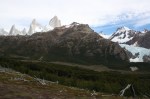
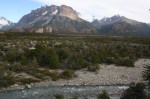
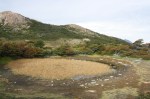
Some of our views on the hike back:

Another view of Fitz Roy

Even the rocks in Patagonia are happy.

Laguna Capri

It’s hard not to look back when things are this beautiful.

On our final descent, the sun started to set over Chalten. This picture does no justice.

There’s a lot of useful information online about this hike if you’d like to take the same route.

How we did it:

From Chaltén shuttle 20 minutes to Hosteria El Pilar, a hotel 17 kilometers (10 miles) from town. Take the trail to the right of the Hosteria, keeping the river on the right. Continue straight; follow sign for Rio Blanco. After about 5 km you’ll reach a T-intersection. Turn right to pass through Campamento Poincenet. Turn left to go back to Chaltén. If continuing on, follow signs for Laguna de los Tres and Campamento Rio Blanco.

The hike back:

After climbing down the mountain, pass through a flat section of wetlands and wooden boardwalks. Turn LEFT at T-intersection toward El Chaltén and Laguna Capri. At next intersection veer RIGHT uphill and turn RIGHT toward Laguna Capri. Continue straight through Campamento Capri and follow signs for Chaltén.

And of course after the hike, don’t forget to stop in at La Cerveceria, a local microbrewery. A very rewarding stop after a full day of hiking.

Happy Trails!

Patagonia: El Chaltén: The Heart of Patagonia

You know how certain places give off a certain feeling and in return evoke a certain feeling within you? El Chaltén is one of those places. It’s a town that completely captures you. It’s a certain kind of paradise.

El Chaltén is a small village set within a valley at the base of the Cerro Fitz Roy and Cerro Torre mountain ranges, the two most iconic mountain ranges in Argentina. Known as the unofficial national trekking capital of Argentina, the town is a part of the Parque Nacional Los Glaciares.

El Chaltén formally became a town in 1985 when a territorial dispute between Argentina and Chile intensified. To fully claim the land the clever Argentines built houses and started living there. When it was time to make a decision, Argentina got the land because they already occupied it.

Before Chaltén was an official town, early pioneers inhabited the area. Andreas Madsen, one of the most well known pioneers in Chaltén, came to Argentina from Denmark in the early 1900s. When we hiked in Chaltén we saw his house in the distance and our guide told us the story.

Andreas Madsen worked as a cook on an expedition with the famous Argentine explorer, Perito Moreno. So enamored by the natural landscape he built a farm, Estancia Fitz Roy, and settled there with his house facing the mountain. He returned to Denmark to find the love of his life, found her, married her and brought her back to Patagonia. They raised their four children (one named Fitz Roy) on the farm. They were truly out in the middle of nowhere, living off the land and surviving through Patagonia’s harshest conditions.

                                “Patagonia!” he cried. “She is a hard mistress. She casts her spell.

                               An enchantress! She folds you in her arms and never lets go.” 

I found this picture of the Madsen house online.

Andreas wrote two books: “Patagonia Vieja (Old Patagonia)” and “Cazando Pumas (Hunting Pumas)” which I’d love to read, but I can’t seem to find much information about online.

I absolutely loved everything about El Chaltén. Similar to saying just Calafate, you can refer to it as Chaltén. The name is prononuced exactly as it looks. Chal and then ten.

Chalten From Above

Chaltén felt much more real to me than Calafate. There was no center of town or shops overdone with souvenirs. There were no supermercados, just a few grocery markets. Most of the people there were there to climb, hike or explore the outdoors. Chaltén felt the way Patagonia should feel.

This slideshow requires JavaScript.

You know when you meet someone that listens so intently and truly cares about what you have to say, someone that isn’t afraid to express their feelings, someone that touches your life just by being present, someone that is so refreshing to meet, someone that is completely real. Chaltén is that person. Chaltén is genuine, down to earth, simple and peaceful. When it’s located in such a beautiful part of the world and inside a national park, it’s hard for a place not to posses those characteristics.

There’s something about mountains that bring serenity to a place, to people who live there. Chaltén rests comfortably at the mountains’ feet, like a child being watched over by a grandfather. The mountains exude their wisdom and patience down to Chaltén. Can you imagine being invigorated with this every single day?

Pondering the possibilities of the day by gazing out our hotel room’s window.

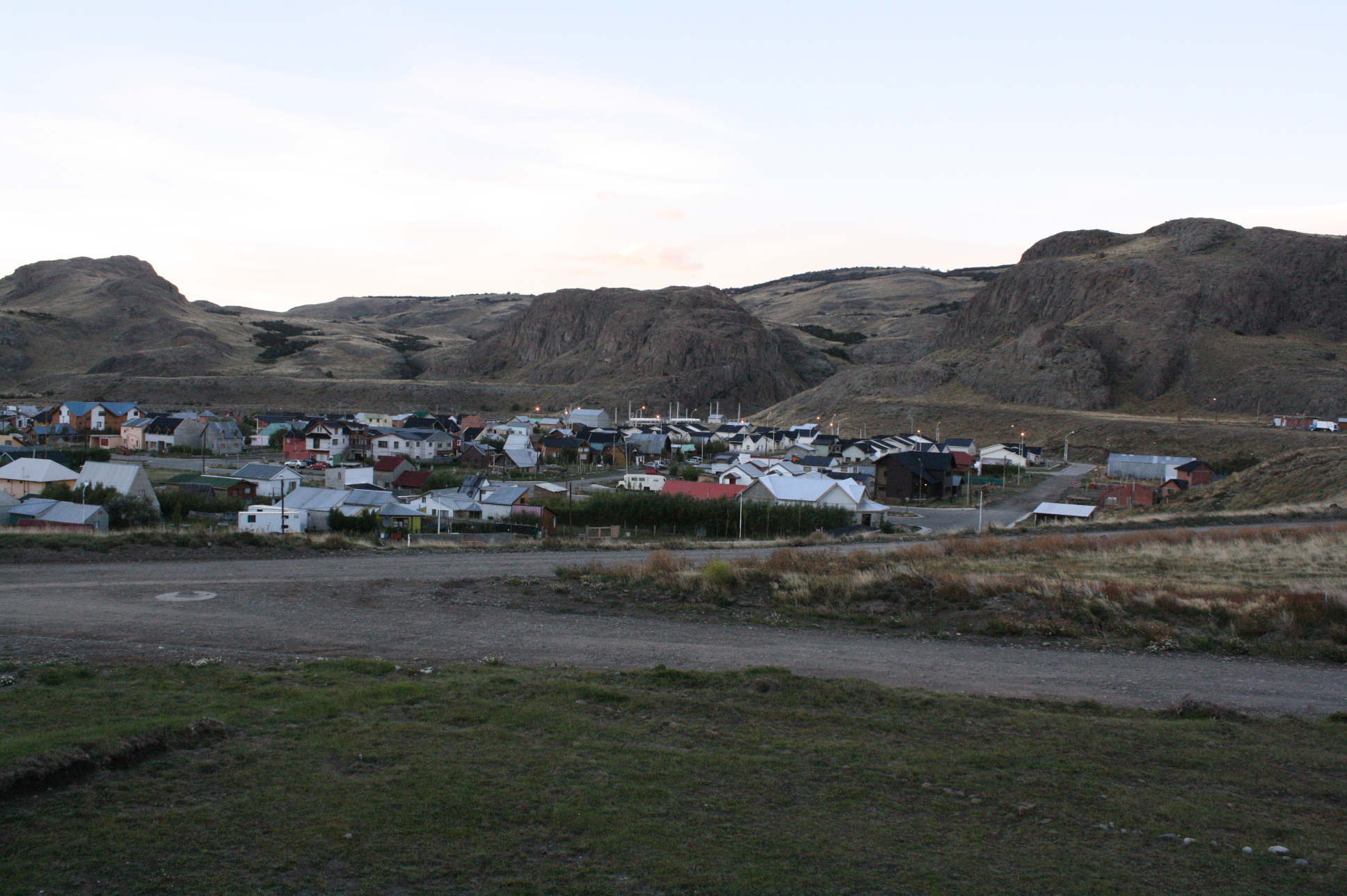
Chaltén is one of those places that still belongs completely to the Earth. Some streets are paved; some streets are just mud and gravel. I can’t find a reliable source online, but it seems that the town’s permanent population is generally around 1,000 people, maybe less. With a lot of the houses it was hard to tell what stage the construction was in. I couldn’t tell whether they were abandon or being fixed up. There isn’t an efficient home telephone network or cell phone service; internet connection is slow and expensive. There are no banks or money exchange places. I think there’s one ATM. No mayor, churches, newspapers. Because these general distractions from life are eliminated in Chaltén, you feel even more plugged in with the natural environment. You feel incredibly connected to nature.

Tips: There is no fee to go hiking or climbing in the park. If you plan on climbing you just need to register with the park service before you go.

The name Chaltén derives from the native Tehuelche’s word which means “smoking mountain.” The Tehuelches called the Fitz Roy mountain, “Chaltén” because there was always a cloud of smoke around its peak. They thought it could even be a volcano.

Perito Moreno renamed the mountain Fitz Roy in honor of Robert Fitz Roy, the captain of the Beagle, Darwin’s ship. But the name for the town stuck.

Chaltén is about a three hour bus ride from Calafate. Before the airport was built in Calafate in 2000 the only way to Chaltén was a ten hour bus ride from Rio Gallegos.

We spent three nights in Chaltén at the hotel Los Cerros. We spent two and a half days hiking in the national park. Those days were some of the most incredible days of my whole life. Stay tuned for another post that includes jaw-dropping pictures of the days spent hiking in Chaltén.

I left piece of my heart in Chaltén and will definitely make my way back someday.

Our hotel in Chaltén

View from our room

Patagonia: Days 1 and 2: El Calafate and Backroads

Before our hiking trip started, my Aunt and I spent the day exploring El Calafate (pronounced cal-a-fa-tay).

El Calafate is a town nestled on the southern part of Lago Argentino, the third largest lake in South America and largest in Patagonia. Tourism sprouted in the 1930s when mountain climbers from Europe began traveling to Patagonia. Before tourism, sheep farming was the main source of income. Before sheep farming, people tried to colonize Calafate but to no avail. Charles Darwin went to Calafate in 1834 on his famous voyage of the Beagle. While sheep farming does still exist in El Calafate, if you take one trip there you’ll see that tourism has taken over.

The population is roughly 15,000 in the summer (December to March-ish) and 6,000 in the winter.

Tip: When talking about El Calafate, you can shorten it to just Calafate. 

The name calafate is derived from a bush with yellow flowers and berries. The calafate berry is similar in size, shape and color to a blueberry. Just a tad bit smaller. There’s also a legend behind the berry.

Note the thorns. Because of the thorns the berry is harder to pick and therefore more expensive.

There are different versions of the legend, but this one is more or less the most common one. Years and years ago when the Tehuelche tribe trekked north for winter, an older woman, Koonex, was too fragile to make the trip. She stayed in her tent and was left alone to die. She asked the birds to stay with her but there was nothing for them to eat in the winter so Koonex turned herself into a calafate bush – thick with berries for their food and with sharp thorns to protect them from animals. In Spring, when the tribe returned, they were greeted by beautiful bushes with golden flowers. The flowers eventually turned into berries. The Tehuelche loved the berries so much that each year they returned to where the berries grew. Now people say that if you eat calafate berries you will return to Patagonia.

There were lots of cute homes in El Calafate.

Avenida del Libertador: the main street in El Calafate. Filled with eateries, souviner shops and boutiques.

Even though the downtown area (the Avenida Libertador) was easily accessible and filled with shops, Calafate felt too touristy to me. Most of the shops had the same exact souvenirs: mate gourds, leather belts, cowboy hats, wool blankets, calafate jam. Everything seemed like it was made for tourists. Things they thought we’d want to buy.

Although I did get some knickknacks, I wanted to buy something that the locals bought. A real souviner to me is something that locals would also buy and use. If you’re looking for something like that then definitely check out the Paseo De Artesanos area on the main street next to the casino. Local artists open booths to sell their work. I bought a hair wrap and hand painted book mark here. My friend bought a mask made from a lenga tree. The only tricky thing is that there isn’t a set of hours they’re open. The booths are open whenever the artist feels like being there. Although they did seem to be open Friday and Saturday nights around 8.

Calafate is one of those towns you go to on your way to somewhere else. It’s a hub for people traveling to different parts of the Parque Nacional Los Glaciares, especially the Perito Moreno Glacier. You fly in to Calafate, spend a night in town and then figure out where you’ll go next.

A wonderful thing about El Calafate:

Lavender bushes were everywhere.

Day 2 in Argentina but Day 1 for our Hiking Trip:

We met up with everyone on the Backroads trip.

Before I dive into our day and the details of El Chalten, I’ll explain Backroads.

Backroads is an active travel company that specializes in cycling, hiking, and multisport trips all over the world. They set up our hiking itinerary, lodging, transportation (minus the flight) and meals. We had two Backroads guides the whole trip and we had local guides throughout the trip.

Backroads goes above and beyond just planning a simple hiking trip. Along with hiking, the Backroads trip included an empanada cooking lesson, an Argentine wine tasting, a mate ceremony, a cordero assado and more. Backroads wants to make sure you really get to experience the full culture of a place. I can’t say enough good things about Backroads.

Our hiking itinerary was incredible. The hiking trip was eight days, and we hiked around 80 miles total. Every single day was more and more thrilling. Our guides were extremely knowledgeable about Patagonia; we had a history lesson multiple times a day. Not only were they knowledgeable but they were amazing individuals who were constantly making our group smile and feel comfortable. I’d definitely go on a Backroads trip again and recommend the company to anyone.

Check out their website here.    View our itinerary here.

The whole trip was very special. There were about 18 of us plus our two guides. The trip was composed of mostly couples in their 30s to 60s. I enjoyed spending time with everyone on the trip and by the end, I felt like everyone adopted me as their niece.

On that first day we drove down the infamous, Route 40. With its romance and ruggedness this route is similar to America’s Route 66 or Route 60. It’s the sole road that goes from Northern Argentina to Southern Argentina. Che Guevara traveled Route 40 by motorcycle; Butch Cassidy and the Sundance Kid used it as an escape route.

It was a beautiful, clear day and we were able to see Cerro Fitz Roy in the distance.

Out the window low, scrubby bushes and desert-like land stretched for miles. The mountains loomed in front of us. We were barely ten miles out of Calafate and it seemed like we were once again in the middle of nowhere.

Just as our guides were talking about guanacos and how we’d be lucky to see one, one sprinted out! They’re native to South America and similar to camels.

We ate a picnic lunch at La Estella, this cute lodge overlooking Lago Viedma and then we went for a quick 2 mile hike through the sand dunes to stretch our legs.

Then we continued to El Chalten, paradise on Earth. Read all about Chalten in the next entry.

Patagonia: The Journey To The Edge of The World With Travel Tips

Getting to El Calafate from New Jersey took a full 24 hours.

We had an overnight flight (about 11 hours) from NY JFK to Buenos Aires Ezeiza International Airport (EZE).

Then we took an hour and a half bus ride (we took the Manuel Tienda Leon bus) to another airport in Buenos Aires (the city is commonly referred to as ‘BA’) Aeroparque Jorge Newbery. Using the airline Aerolineas Argentinas we flew 2 and a half hours to El Calafate. From there we shuttled about 30 minutes to our hotel. Along with waiting times and drives, we spent a full day traveling.

The line on the map shows a general idea of our journey. But instead of flying through Chile we flew to Buenos Areas, which is on the east coast of Argentina, close to Uruguay.

Our flight to El Calafate was going all the way to Ushuaia, the southernmost city in the whole world. That’s when the geographical impact of the trip hit me. I was on my way to Patagonia, the very edge of the world.

While we’re on the topic of location, let’s pause for a minute to clear some things up. Every time I told someone I was going to Patagonia I’d usually get “Huh? Ohhhhhh, okay. Yea, cool” as a response. You could see in the person’s face that they kind of knew what I was talking about but really, they didn’t have any idea.

While I was at Sports Authority trying on snow boots an employee even said to me, “Can’t you just go to Vegas for Spring Break?” But I’ll have to admit, when I first found out about the trip I wasn’t exactly sure what it meant either. Sure, I knew about the mythical reputation, jagged peaks and wide open spaces, but I didn’t fully understand the depth of the place. This confusion boils down to two main questions: What exactly is Patagonia? Where exactly is Patagonia? 

Roughly occupying a combined surface area of Texas and California, Patagonia is not precisely marked by borders. The name generally refers to the area of land hugging southern Argentina and southern Chile. Patagonia takes up 1/3 of Argentina but only 5% of the population (around 2 million) lives there.

Different stories circulate about its name, but legend has it that when explorer Ferdinand Magellan passed through Patagonia in the 1500s he saw giants. Patagon means large foot in Portuguese, and so the name Patagonia was born.

Patagonia is a land known for its remoteness, for its unparalleled beauty, for its loneliness, for its possibility, for its appeal to the wanderer, the drifter, the adventurer. Untouched land, wild, free.

As we flew over El Calafate I jotted this down in my journal:

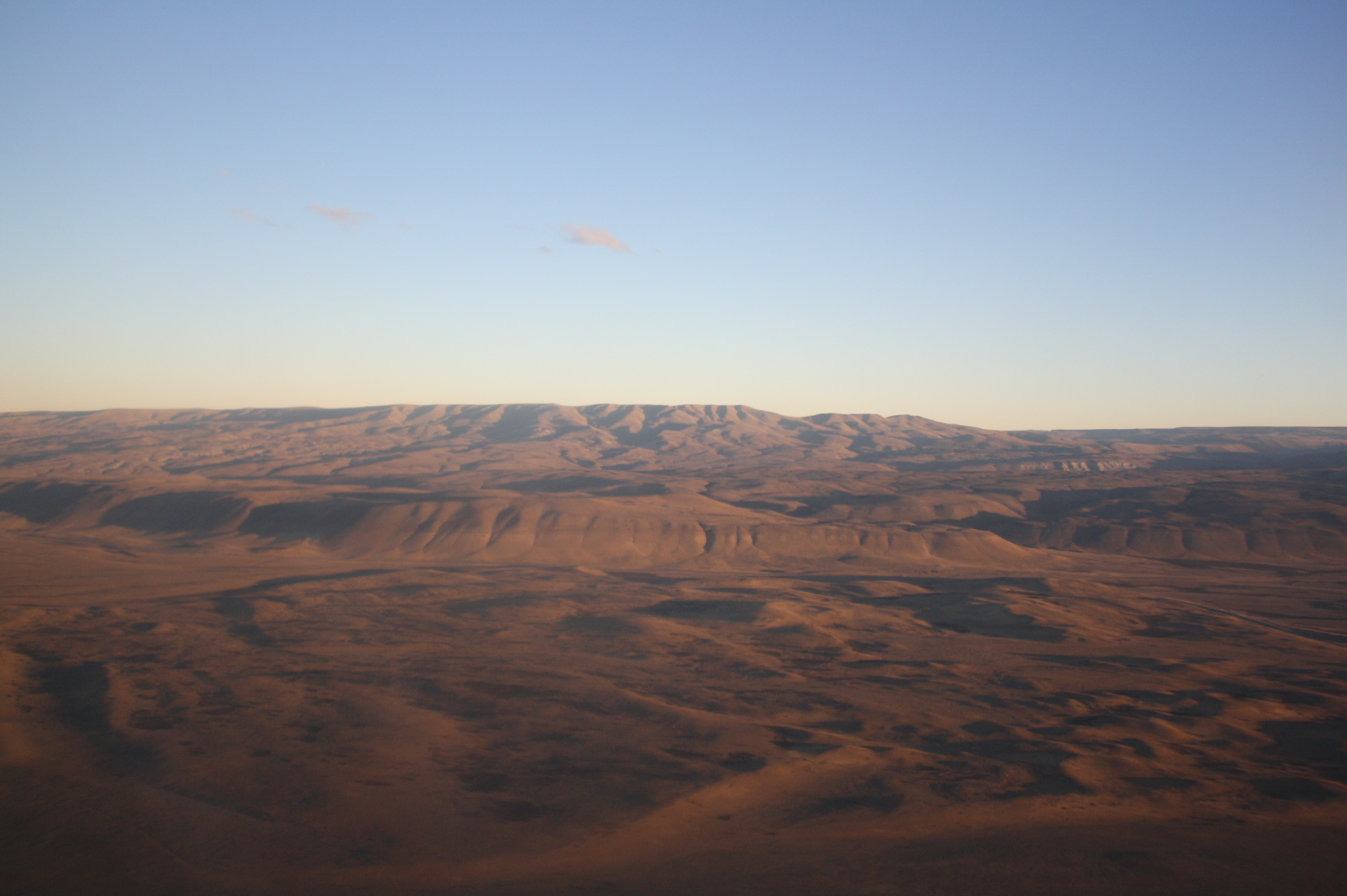
Flying over Patagonia I can’t help but wonder, ‘Where are we? Am I living in a dream?’ Barren, vast emptiness stretches out in all directions. Nothingness as far as the eye can see. Yet there’s something so appealing in this emptiness. Brown dirt formations. It almost reminds me of a desert, of flying to Phoenix, but it looks like it’s never going to end. You can’t see an airport. You can’t see anything. As the plane descends it still looks as though we’ll be dropped off on a mountain with nothing but mountains and sky surrounding us. We have arrived at the edge of the world.”

Useful Information if traveling to Argentina: 

Because we’re United States citizens we had to pay a reciprocity fee of $150 U.S. dollars once we got to EZE. In 2009 the  Argentine Government set an entrance fee for US citizens, Canadians and Australians. The fee is the same amount Argentine citizens must pay when requesting a Visa to travel to these countries. This fee lets US citizens travel to and from Argentina for ten years.

We paid the fee, went to another line for questioning, got our passports stamped, got our luggage and put our luggage through security. Then we entered the airport at the American Airlines terminal.

If you’re unsure of how you’ll get to your next destination, don’t worry at all. Right away there are  information booths for taxis and the Manuel Tienda Leon bus.

Don’t rely on the first money exchange company you see. The company, Global Exchange or something like that, offered 3.7 pesos for $1. I walked by them, turned the corner and saw Banco De La Nacion Argentina which offered around 4.3 pesos for $1.

Most of the signs list the word in English right after the Spanish word so even if you don’t speak Spanish, it’s easy enough to get by.

Recommended airline: Lan Chile.

Patagonia: How My Journey All Started

Over this past Holiday season I was still a few months out of college, freshly back from a road trip and overseas trip, not ready to dive into a full-time job and pretty much just open-minded to where life took me. At my Mom’s annual Holiday party I gathered in the kitchen just as my Aunt Kate was talking to someone about her next hiking trip.

She was upset because she could only go a certain time of year, but her traveling companion (her son) wasn’t able to attend at the same time. Somewhere in those couple minutes of conversation our eyes met and she asked, “Do you want to come with me?” I heard the words Patagonia, South America, hiking. Without hesitation, I said yes.

At that moment I didn’t know much about Patagonia, but I had heard it was wild, open land. Beautiful natural space. That combined with hiking was more than enough for me. Over Thanksgiving I went with my Aunt Kate to England so I knew I had a great travel companion.

My Aunt Kate always said to me something along the lines of, “I believe that if people are genuinely good then good things will come to them naturally.” Add in a dash of being at the right place at the right time and voila, my Patagonia trip was born.

Review: Apache Lake Music Festival

When I found out a music festival including my favorite Arizona bands was occurring on my birthday, I knew I had to go.

Apache Lake Music Festival was Friday, October 1st and Saturday, October 2nd, but I only went on Saturday.

This won’t be much of a review of the show because I didn’t catch all of the bands, but I’ll share bits of my experience from what I did see.

(This was our breath-taking view for a majority of the ride.)

After driving through an hour of soaring canyons and jagged rock formations at elevations of 1,900 feet along a cliff’s edge, we made it to Apache Lake around 4 p.m.

We were able to catch the very end of the Sugar Thieves’ soulful set. (Good thing they play in Tempe frequently so I can catch them again soon.) As the set was ending, the light drizzle turned into thick raindrops and everyone frantically moved the equipment inside. Thankfully the bands were able to continue playing inside. Inside they were also able to play longer sets. So even though the outside stage was set against a beautiful backdrop, being inside wasn’t too bad at all.

Black Carl, the first band to play inside, broke it down with Emma Pew’s raspy powerful voice. They finished their set with a badass beat boxing rap about all kinds of fabulous gangsta activities.

I was too busy enjoying myself to even remember where I placed my camera. I retrieved it for What Laura Says and snapped these pictures:

What Laura Says

What Laura Says

What Laura Says

What Laura Says

What Laura Says

Once again What Laura Says captured my body into a dancing frenzy. (If you couldn’t tell by the movement in the pictures.) They opened with two songs from Bloom Cheek, “Training” and “On the Fence” (Same as when I saw them a week before. Check out that review on my other blog here.) played an upbeat whirl of psychedelic rock songs throughout and then finished with two covers.

I almost lost it when they played my favorite Beatles song, “I Want You (She’s So Heavy).” This was definitely my favorite part of the night.

As they closed out with a rock-induced version of Sly and the Family Stone’s “Thank You (Falettinme Be Mice Elf Agin)” everyone couldn’t help but belt along. I definitely was able to be myself so thank you What Laura Says.

After that I only caught bits of Dry River Yacht Club’s set and Strange Young Things’ set. I’ll admit– I was too busy celebrating my birthday at the bar and meeting people outside.

But overall it was a really great festival filled with a great atmosphere, great energy, good vibes and good people. Wherever you went people were waving, smiling and saying hello. A festival with the sound of laughter, feet stomping and tunes vibrating is a good one to me.